Pear 'Beth'
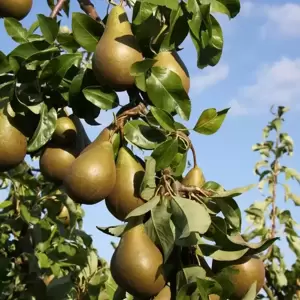
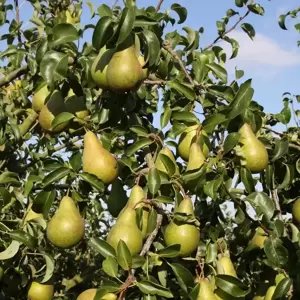
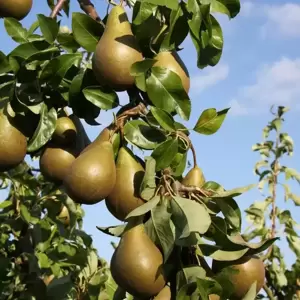
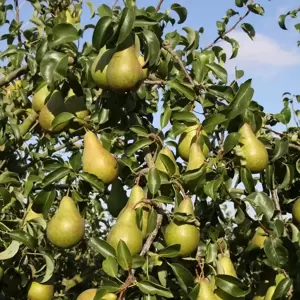
Pear 'Beth' is a compact and reliable dessert pear producing attractive small to medium-sized yellow-green fruits. The pears have sweet, juicy flesh with a pleasant flavour and are ideal for eating fresh from the tree.
White blossom appears in spring, providing an attractive seasonal display and a useful source of nectar for pollinating insects. The fruits are ready to harvest from early to mid-September, making 'Beth' one of the earlier pear varieties to ripen.
Best grown in a sunny, sheltered position in moist but well-drained soil, 'Beth' is a dependable and productive choice for gardens. It belongs to pollination group 3 and will generally produce the best crops when grown near another compatible pear, although it is capable of setting some fruit without a pollination partner.
- Sweet and juicy dessert pear
- Small to medium yellow-green fruits
- Early cropping variety
- Harvest from early to mid-September
- Attractive white blossom in spring
- Pollination group 3
- Reliable and productive variety
- Best grown in full sun in a sheltered position
- Height 300cm - Spread 300cm
Pyrus communis
-
EAN code5038838110887
- Brand
- Pot Size11.5L
- AspectSouth-facing, West-facing
- Attractive to WildlifeAttractive to Bees
- Flower ColourWhite
- Flower FormSingle
- Foliage ColourGreen
- Foliage TypeDeciduous
- Fruit ColourGreen, Yellow
- Fruiting PeriodSeptember
- Garden StyleFruit Garden
- Hardiness - RHS ratingH6 -20 to -15c. Hardy - very cold winter
- MoistureMoist but well-drained, Well-drained
- pHNeutral
- Plant HabitSpreading / Branched
- Plant TypeEdible
- RootstockQuince Eline - Dwarf
- Soil TypeClay, Loam, Sand
- Special AttributesBerries or Fruit, Self-fertile
- SunlightFull Sun
- Uses for the VarietyEating
Fruit Tree Pollination
All fruit trees will crop satisfactorily in an urban situation as insect pollination activity covers considerable distances.
Below is some useful information for all you need to know about pollination.
Self Fertile
Look out for the Self Fertile symbol on our fruit labels. This means your tree will crop satisfactorily on their own. Each of the fruit groups have varieties that are self fertile, a few in apples, pears and cherries and all apricots, nectarines and peaches.
Flowering Groups
Look out for the Flowering Group symbols, flowers with numbers 1-5. Each of the fruit trees are divided into 5 flowering periods. This covers approximately a month from beginning of period 1 to the end of period 5. For trees to cross-pollinate they need to be the same or adjacent flowering group, e.g. an apple tree of flowering group 3 will cross-pollinate with those of groups 2, 3 and 4.
Good Pollinator
Particularly good pollinators are highlighted by our bee symbol.
Triploid
Triploid varieties are marked with this symbol in the fruit sections. To pollinate, they should be accompanied by two other non-triploid varieties that will also pollinate each other or one variety that is self fertile.
Top Tips
- Two trees of the same variety will not pollinate each other unless they are self fertile.
- Always bear in mind that crop yield will be affected by adverse weather and in these circumstances it is helpful to have several different varieties that provide strong and ample pollen for cross pollination opportunities.
- It is quite normal for trees to have a light cropping year after a heavy one – like us they need a rest after a big effort. See more on this below under Biennial bearing
- For fruit trees to pollinate one another they need to be of the same type e.g both apples or both pears.
Apples & Pears
Follow the tips above for guidance for apples. Apples are regular croppers and Malus crab apples are excellent pollinators for fruiting apples.
Pears
Follow the tips above for guidance for pears. Pears prefer to have a warm sheltered position to set a good crop.
Plums, Gages, Damsons and Mirabelles
Most varieties are self fertile. The few which aren't are unlikely to need a pollinator unless planted somewhere very remote.
Cherries
Most good garden varieties are self-fertile. All self-fertile varieties are known as 'Universal Donors' in that they will pollinate any other cherry trees that flower at the same time, so if unsure then just include at least one self-fertile variety in your garden. Sour cherries, such as Morello and Meteor Korai, are all self-fertile, they can pollinate sweet cherries but sweet cherries will not pollinate them.
Peaches, Nectarines, Apricots, Almonds, Medlars & Mulberries
All varieties are self fertile so don't need a pollinating partner.
Quinces
A few Quince varieties are self fertile. Other varieties may need to be accompanied with a pollinator.
Walnuts
Broadview and Buccaneer are the two self-fertile varieties we would recommend for gardens. Other varieties are likely to be partially self-fertile and would benefit from nearby pollinators. Walnuts are pollinated by wind rather than insects so bear this in mind when choosing your site.
Hazelnuts
Hazels will crop better if varieties are mixed together but due to the abundance of hazels in the wild, good crops usually appear. Like walnuts, pollination is mostly carried in the wind.
Malus Crab Apples
These are a very useful range of trees where many varieties will pollinate apples. Mostly all ornamental Malus are self fertile themselves, indicating how useful their pollen is for cross pollination.
Biennial bearing
Some fruit trees can produce a heavy crop one year followed by a much lighter crop the year after, this is known as ‘biennial bearing’ or ‘biennial cropping’. Traditional or ‘heritage’ varieties tend to be more biennial bearing than many modern varieties that have been bred to crop more regularly every year. Biennial bearing is a natural phenomenon as a heavy crop can exhaust the tree’s resources leaving it with insufficient energy to set much fruit bud for the following year.
It is possible to manage the tree to produce a more regular yearly crop by using the following methods:
- In the ‘on’ year thin the fruit before it ripens and summer prune before July.
- Following an ‘off’ year heavily prune in the winter to reduce the likely heavy forthcoming crop.
- Repeat either of these remedies as necessary until the tree settles into an annual cropping habit.
The majority of our national delivery options fall under the categories below. Certain oversized or age restricted items carry an additional delivery charge, however this will be clearly displayed in your basket before checkout.
Tracked Delivery (Express) - £7.99
Zone 1 - England, Wales & Scotland (excluding Highlands & Islands)
- Orders are dispatched within 3-5 working days
- Parcels are sent via DX or DPD on a next day service, requiring a signature on delivery or safe place instructions
- Fully tracked from door to door with text or email notifications along the way to keep you informed
- 2 hour time slot notification
- Dispatch days Monday - Thursday (excluding Bank Holidays)
- Delivery days Tuesday - Friday
Tracked Delivery (2-4 Days) - £14.99
Zone 2 – Highlands & Islands of Scotland
- Parcels are sent via a tracked 48 service, requiring a signature on delivery or safe place instructions
- Tracking code provided on dispatch. Email or SMS notification on day of delivery
- Orders dispatched within two working days
- Please expect 2-4 days for delivery
- List of applicable postcodes
Tracked Delivery (3-4 Days) - £14.99
Zone 3 – Isle of Man, Isle of Wight & Isles of Scilly
- Parcels are sent via a tracked 48 service, requiring a signature on delivery or safe place instructions
- Tracking code provided on dispatch. Email or SMS notification on day of delivery
- Orders dispatched within two working days
- Please expect 3-4 days for delivery
Parcel Tracking
Your order will be sent using a fully tracked service, providing us with some information on the parcel's status, location and route. It also allows us to provide you with the same information. Once your order has been dispatched you will receive an email (please check spam/junk email folders) with a tracking code and instructions on how this information can be retrieved.
Write a review about "Pear 'Beth' (Quince Eline) - Patio"
We want to know your opinion! Write a review about the product “Pear 'Beth' (Quince Eline) - Patio” and get a chance to win a National Gardening Gift Voucher of £25!